CubePart: An Open-Vocabulary Part-Controllable 3D Generator
A design-studio catalogue on cream stock: a violet-to-jade serif wordmark, black pill buttons, and toy-like 3D parts that come apart under a slider.
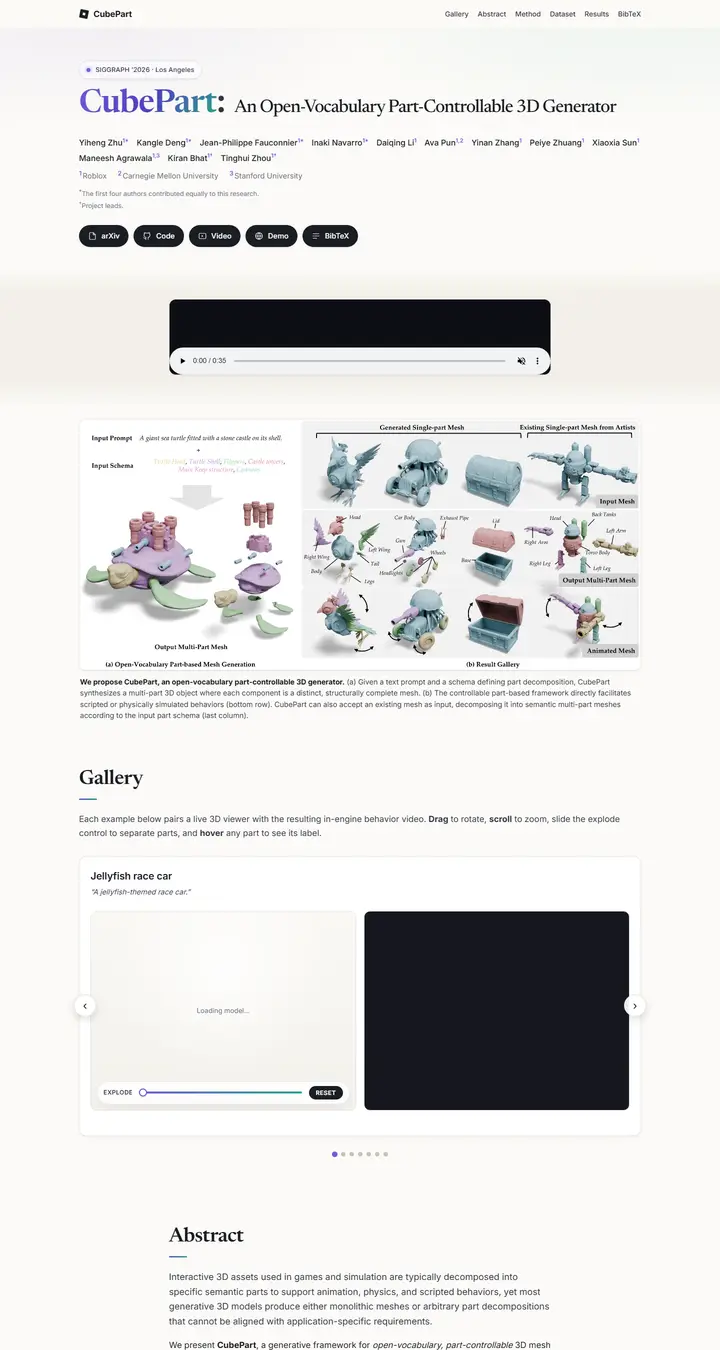
Checked against the rendered page. Hero video rendered as an empty black player and the 3D viewer showed 'Loading model...' at capture time; documented as capture artefacts.
Why it is here
Gradient wordmark with a serif subtitle, pill buttons and a well-framed teaser with caption. The interactive gallery card with an explode slider is attractive. It loses points because the video and the 3D viewer were captured blank or still loading.
Overview
Color Palette
Typography
Newsreader
CubePart: An Open-Vocabulary Part-Controllable 3D Generator
Abstract · Method · Results · BibTeX — 0123456789
Inter
CubePart: An Open-Vocabulary Part-Controllable 3D Generator
Abstract · Method · Results · BibTeX — 0123456789
JetBrains Mono
CubePart: An Open-Vocabulary Part-Controllable 3D Generator
Abstract · Method · Results · BibTeX — 0123456789
Spacing & Shape
Page Modules
Guidelines
More like this
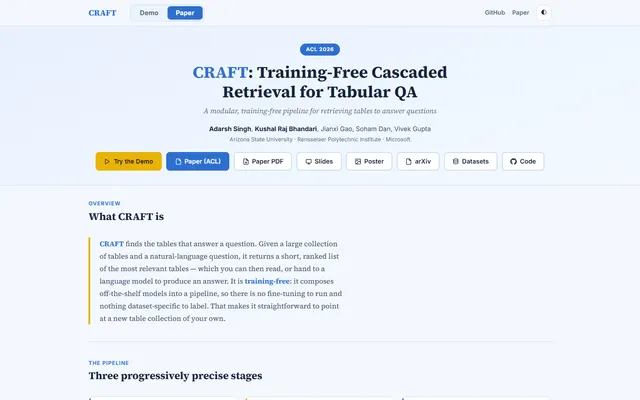
CRAFT: Training-Free Cascaded Retrieval for Tabular QA
A tidy product manual in pale blueprint blue, where every stage wears its own colored edge.
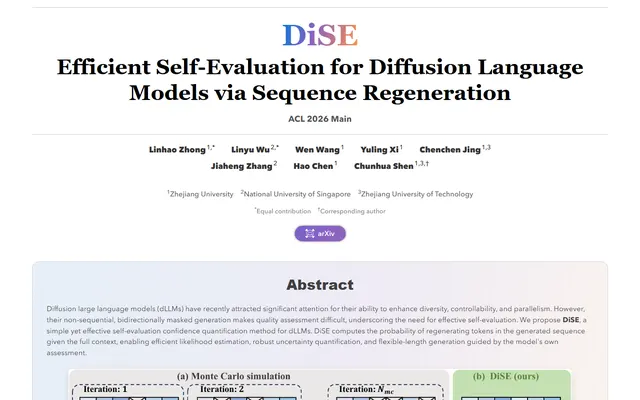
Efficient Self-Evaluation for Diffusion Language Models via Sequence Regeneration
A tidy stack of rounded cards washed in a blue-violet-apricot dawn, signed with a gradient wordmark.
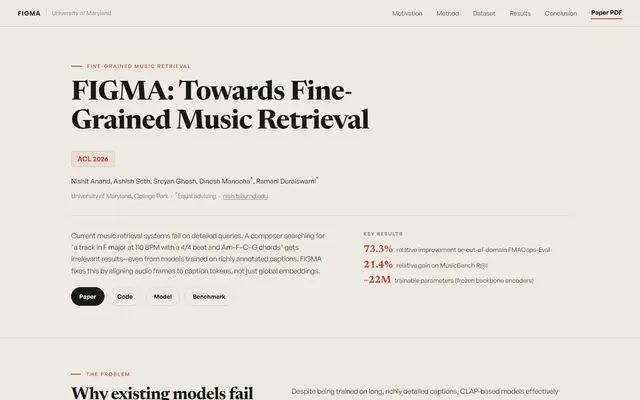
FIGMA: Towards FIne-Grained Music retrievAl
A music journal on warm paper: a heavy Newsreader headline under a red kicker, big red serif numerals for the results, and figures resting in soft cream frames.
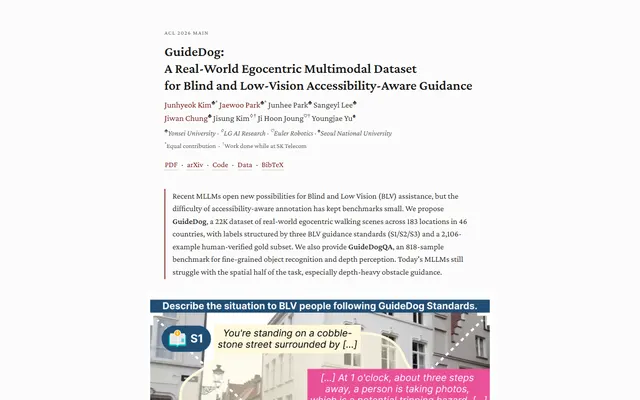
GuideDog: A Real-World Egocentric Multimodal Dataset for Blind and Low-Vision Accessibility-Aware Guidance
A quiet monograph page: one serif column, oxblood ink for the links, and a table that blushes only at its own row.
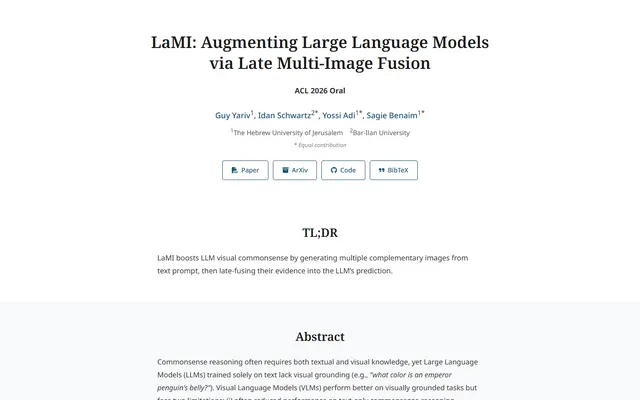
LaMI: Augmenting Large Language Models via Late Multi-Image Fusion
A careful conference handout: Noto Serif headings, navy outlined buttons and soft grey bands taking turns.
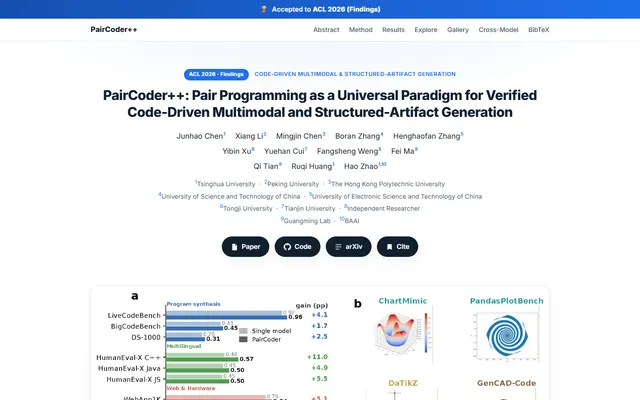
PairCoder++: Pair Programming as a Universal Paradigm for Verified Code-Driven Multimodal and Structured-Artifact Generation
A crisp white product page: a blue announcement strip, ink-black pill buttons and every figure on a soft-shadowed card.